
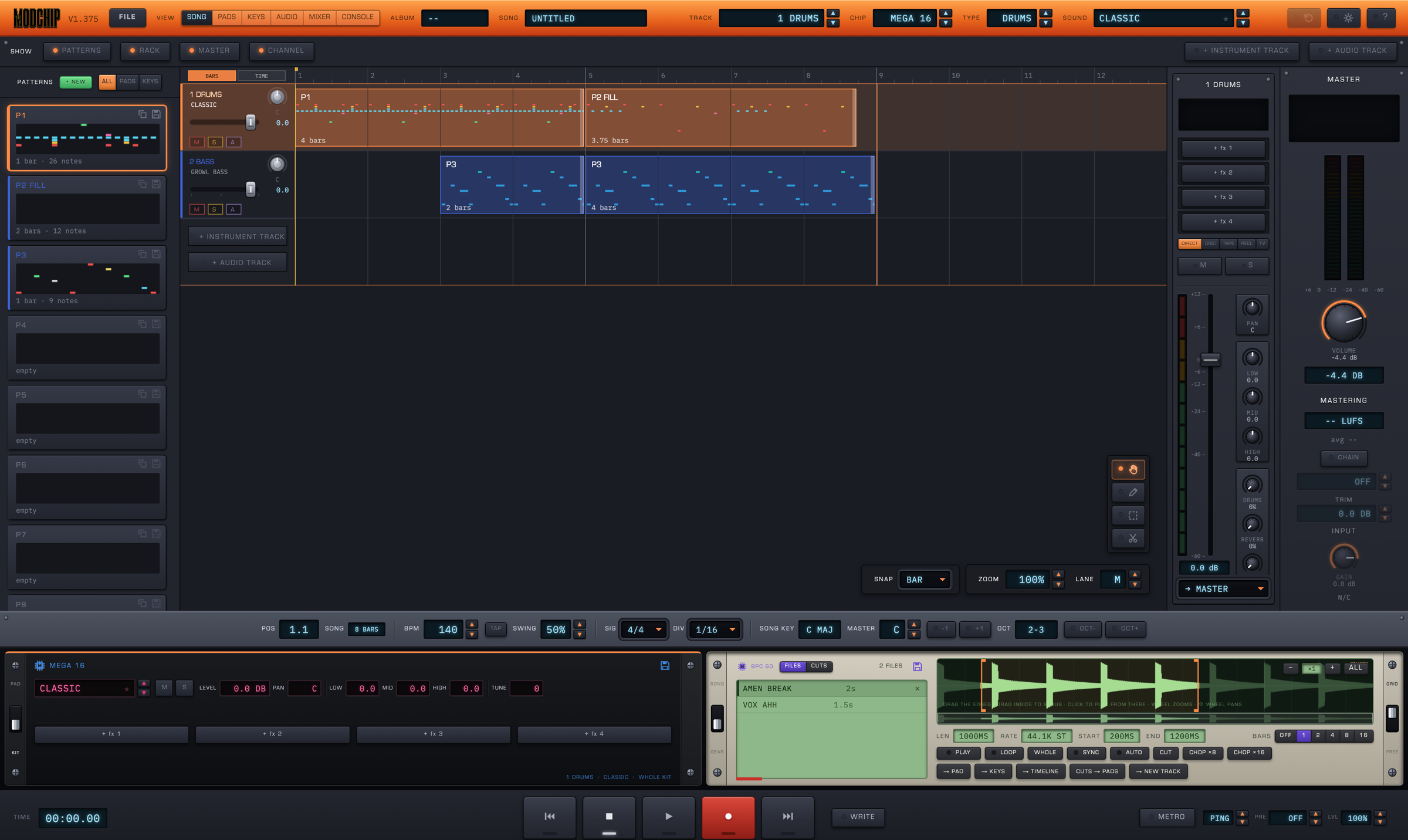
A chiptune DAW for the Mac. Nine chips, each a real emulation with its own voice. No samples, ever: every factory sound is a chip or our own synthesis. Patterns, a piano roll, a song page, audio tracks, a desk, and a console you type into.
Each one is the machine it came from, emulated in full, with its own face in the app, its own library of sounds and kits, and the quirks that made it sound like itself. Click a card for what is inside it; press HEAR IT for a demo song that leans on that chip.
Click a chip for the full overview.
Six views, one machine. Each is a page of its own with the deck underneath, and Tab walks them in a circle. Here is each one, and everything that lives on it.
Every box is ours, with a house name on top and the plain word for what it is underneath. They go on a pad, an instrument, a channel, a bus or the master, four to a socket, and twenty of them are also programs on the touch pad.
Every song below ships inside the app as a project you can open, pull apart and change. These are the app's own renders of them, straight out of the engine. Nothing was played in.
The engine, compiled for the browser, with a demo song already loaded. Play it, pull it apart, swap the sounds, draw your own notes. No install, no sign-up.
The Mac build is in its last stretch before the beta: a signed, notarised app you can open without any warnings. The beta list is where the first download goes out.
macOS 12 or later · Apple Silicon · a window of at least 1760 by 1080
Modchip is a chiptune and beat-making app for the Mac. Its sound engine is the sound chips of old games consoles and home computers, emulated in full: a four-operator FM chip from the 16-bit era, an 8-bit console chip with two pulses and a triangle, a pocket handheld chip, two home computer chips, a four-channel tracker machine, a PC FM sound card and a six-voice wavetable chip. You write patterns on pads and a piano roll, arrange them on a song page, mix on a desk and export the result.
A DAW. Modchip is a complete music-making app: sequencer, piano roll, drum pads, song arrangement, audio tracks, a mixer with effects, and export to WAV, AIFF, FLAC, stems and MIDI. It also hosts your VST3 and Audio Unit plugins on its channels. A plugin version of Modchip for other DAWs is on the list, after the Mac app ships.
No. Nothing in the factory library is a sample. Every sound is the emulated chip playing a patch, or synthesis we wrote ourselves. That is why a kick on the 8-bit chip can be retuned, reshaped and driven through effects in ways a sample pack cannot, and why a whole song is a few kilobytes of patterns and patches.
Nine instrument chips and one audio input. MEGA 16 (four-operator FM, six channels, with the PSG beside it), NE8 (two pulses, a triangle and noise), HANDBOY (two pulses, a 32-step drawable wave and noise), COMP 64 (three oscillators, ring modulation, sync and a filter), ZX MICRO (three squares, a noise and an envelope you can play as a tone), MOD 4 (four eight-bit loops, hard left and right, driven like a tracker), DOS FM (nine channels of two-operator FM, four waveforms an operator), WAVE 6 (six drawable waves in stereo that can morph into each other) and BPC 60 (a sampler for whatever you feed it). PCM 16 is the audio input for recording a mic, a line or a deck.
Both. The factory library ships over a thousand patches and a hundred kits, and the kits are written for real genres: trap, jungle, house, lo-fi, electro, industrial and Latin percussion, on every chip. Chip sounds through a compressor, a sub stage, tape and vinyl stages sit in a hip-hop beat as naturally as they do in a boss fight.
No. Modchip works like a groovebox: pads, a step grid, a piano roll and knobs. The tracker-style control is there if you want it, as a console you type into, with a language that reads like English. Everything the console can do, the knobs can do, and the other way round.
Yes. Play the pads and keys from any class-compliant MIDI controller, and MIDI-learn any knob or fader. Automation can be written from the controller too.
Yes. Audio tracks record from your interface through the PCM 16 input, with takes, comping, punch in and out, a gate, a room, and a tune box that corrects pitch to the song's key.
WAV, AIFF and FLAC, the whole song or a seamless loop of one pattern, stems a track at a time, and standard MIDI files. Songs are saved as .modchip files, which are small, text-based and travel well.
The beta is free. Modchip will be a paid app at launch, a one-time purchase rather than a subscription; the price is not set yet, and the beta list hears it first.
A Mac with Apple Silicon and a screen of at least 1760 by 1080. The launch build will be signed and notarised, so it opens without warnings. A Windows version is not planned for launch.
Yes. What you make in Modchip is yours, including the factory sounds in it. No attribution, no licence fees.
It is in the works: a playground with a demo song loaded, where you can play it, change the sounds and draw your own notes, then save the .modchip file and open it in the Mac app. Exporting audio stays with the app.
Leave an address and you get the first build when it is ready, and nothing else. No newsletter, no sharing.